


The Mystery of the “Changing Color” Carpet: Shading, Pooling, and Watermarking
Whether you’re considering new carpeting for your Ventura home or you’ve just purchased new carpeting, we want you to be aware of some changes to expect in your carpet’s appearance so that there’s no surprise when you see it.
It’s a phenomenon known as Shading, Pooling, or Watermarking.
In certain spots—maybe near the hallway or in the center of the living room—the carpet looks darker, almost like it’s wet or has a shadow cast over it. When you walk to the other side of the room, those dark patches suddenly look lighter than the rest of the floor.
At Flooring 101, we’ve served Ventura, Kern, and Santa Barbara Counties for over 50 years, and this is one of the most common “mysteries” our customers ask us about. Let’s talk about it.
What Exactly is Carpet Shading and Pooling?
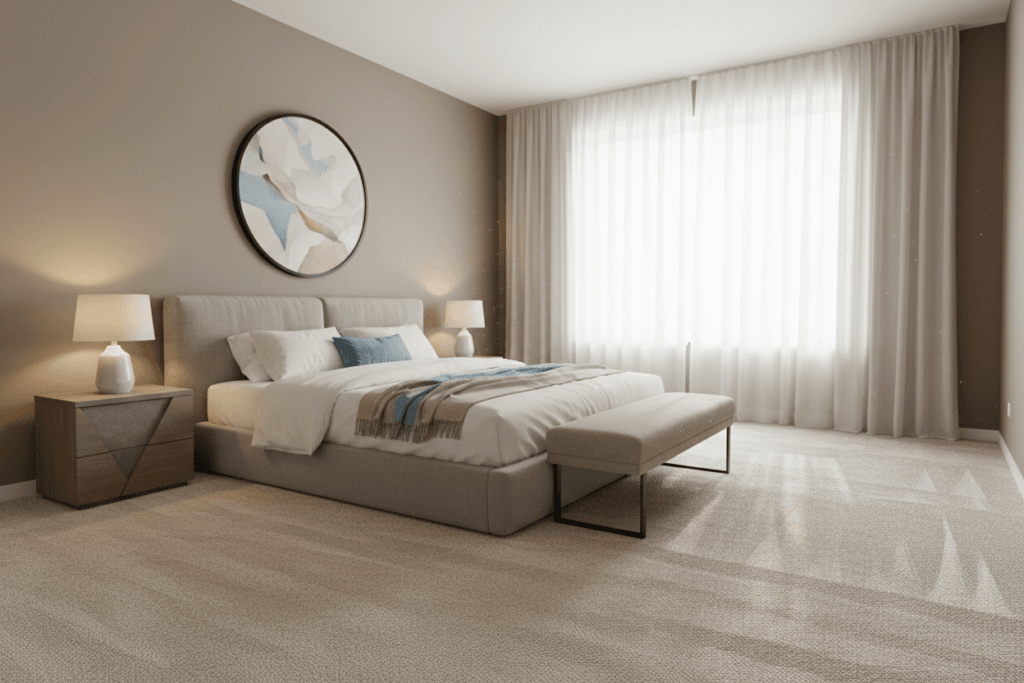
To understand why your carpet appears to change color, you have to look at the anatomy of the carpet fiber.
Most residential carpets are “cut-pile,” meaning the yarn loops are cut at the top, leaving individual fibers standing upright.
The Science of Light Reflection
Think of carpet fibers like the grass on a golf course. When all the fibers lean in the same direction, the light reflects off them uniformly, and the color looks consistent.
However, carpet fibers have a natural “nap” or direction. When those fibers are pushed, crushed, or brushed in the opposite direction—whether by foot traffic, vacuuming, or even localized air currents—they reflect light differently:
- The “Dark” Side: When you look “into” the ends of the fibers, they absorb more light, making the area look darker.
- The “Light” Side: When light hits the side of the bent fibers, it reflects more intensely, making the area appear lighter or even silvery.
Pooling (Watermarking)
While simple “shading” usually follows footprints or vacuum tracks, Pooling (also called Watermarking) is more mysterious. These are permanent, irregular shapes that look like spilled water.
Despite decades of industry research, the exact cause of pooling remains one of the great mysteries of the flooring world.
It isn’t caused by the manufacturer, the installer, or the cleaner—it is simply a natural characteristic of high-density, cut-pile carpets.
Why Is It Happening in My Home?
You might notice this more in certain rooms than others. Several factors contribute to the visibility of shading:
- Carpet Style: Densely packed, high-luster “Saxony” or plush carpets are the most likely to show shading. The smoother and more “velvety” the surface, the more it acts like a mirror for light.
- Lighting Conditions: The bright, natural light in Goleta or Ventura coastal homes can exaggerate the contrast between light and dark patches.
- Traffic Patterns: Areas where people pivot or turn (like at the foot of a bed or in a doorway) are prime spots for “pile reversal,” where the fibers are forced into a new permanent direction.
- Subfloor Undulations: Sometimes, slight variations in your subfloor can cause the carpet to flex differently underfoot, encouraging the pile to lean in a specific direction over time.
Can It Be “Fixed”? Should it Be Fixed?
There’s nothing to fix! Pooling and shading should be expected with carpeting because they are merely physical changes in the direction of the fiber—not a stain or a dye issue—traditional cleaning won’t “wash it away.”
In fact, a deep steam cleaning can sometimes make the patches more visible because the fibers are now clean and reflecting even more light!
Here is what you can do:
- Grooming: Using a carpet rake or a stiff brush can temporarily realign the fibers. This is a great trick for “Temporary Shading” (like footprints), but “Permanent Pile Reversal” will usually return to its shifted state within a few days of walking on it.
- Vacuuming: Vacuuming in one consistent direction can help “train” the pile, though it isn’t a permanent cure for pooling.
- Embrace the Texture: Many homeowners in Simi Valley choose to view shading as a mark of luxury, much like the “shimmer” of a high-end velvet sofa or a suede jacket.
Want to Learn More About Carpeting & Installation Services? Contact Flooring 101
Contact Flooring 101 today to experience the difference that 50 years of local expertise can make. Whether you are looking for a plush sanctuary for your Thousand Oaks master suite or a durable, high-traffic solution for your Bakersfield office, our professionally trained experts are ready to guide you every step of the way.
Visit one of our seven premier showrooms in Oxnard, Ventura, Bakersfield, Goleta, Thousand Oaks, Santa Maria, or Simi Valley to explore the largest inventory in the region. From our “Happiness Guarantee” to our commitment to a “Greener Future,” we make sure your flooring journey is simple, easy, and fun.
Carpet Shading Frequently Asked Questions (FAQ)
Q: Does shading mean my carpet is wearing out faster?
Not at all! Shading has zero impact on the durability or lifespan of your carpet. Your carpet is just as strong in the “dark” spots as it is in the “light” ones.
Q: Why did the patches only appear after a few months?
It takes time for the “memory” of the fiber to change. As you walk on the carpet and the fibers settle into their environment, they may eventually “decide” to lean in a new direction.